The owner's reeve · independent advisors for e-commerce brands
You built the brand.
Someone should be
on your side.
Find what's holding it back. Unlock true growth.
Revenue is up. Is the profit? Everyone around your brand has a reason to tell you what to do. We have one: you. We find what's holding it back, from the product to how you win customers, and design the change, whether that means growth your customers pay back or stopping the losses first. Your team does the work; we stay beside you until it works.
01What we solve
Whatever stands between your brand and a profit.
Sales are up and the bank balance isn't. The agency says ROAS is great. You don't know whether to spend more or stop. We find the cause, from one product to the whole model, design the change and test it in your numbers. Or we tell you to stop.
01Product and range
Your best sellers may be your biggest losses.
Which products make money after fulfillment, fees and ads, and which only look like they do.
Sample brand B: five products lose money once every cost is in. Reprice, bundle or drop them.
02Offer and bundles
The first order has to pay.
What a first order has to look like for a new customer to pay back what they cost.
A coffee subscription lost about $13 on every new customer: a first box that gave too much away.
03Pricing and discounting
Discounts that win customers, or just give margin away.
Where a discount buys a customer who comes back, and where it pays for a sale you'd have had anyway.
Sample brand B: sitewide discounting outside peak costs $206K a year.
04Acquisition and channels
Spend more, or stop?
What a customer is really worth, what you really pay, and which channels pay it back.
Sample brand B can afford $49.23 and pays $31.73: room to grow. The coffee subscription paid $44 for customers worth $31.
05Cost to make and ship
The margin you think you have.
The true cost of a unit on the shelf and a parcel at the door, from every invoice.
Sample brand B: true COGS 37.5% against 36.4% booked; parcels billed above their real weight cost $56K a year.
06The model itself
Change this, or it will fail.
When fixing the parts won't fix the whole, we say so. Then we stop the bleeding, buy time, and design the model that works.
A real plan, below: losing $2.1M a year, and how to stay inside the owner's limit while finding a model that pays.
Examples from fictional sample brand B and from a disguised real analysis.
Sample brand B · what it pays for a customer, and what it can afford
$31.73 $49.23
Its customers would pay back $49.23 each. It pays $31.73, because its ROAS target is set on first orders. That gap is growth it leaves unspent. Sometimes the answer is to grow. Sometimes it's the opposite.
02From our work
Buying time to find a model that pays.
Based on a real analysis, with the product, numbers and timing changed to protect the brand. What the numbers showed, what we recommended, and what the plan projects.
01What the numbers showed
The read
A specialty coffee subscription with a product its customers loved: four in ten subscribers had stayed a year or more. And about $4.8M in sales a year, losing $2.1M.
The ads weren't broken; the account even responded well to cost caps. The model was: a first box that cost more to win than it would ever return.
▲ VerdictNot with today's model. With no changes, losses would pass the owner's $750K limit in month 8.
The offer gave too much away, then looked expensive
First box
$18
two bags and a brewer, worth $62
Every renewal
$34
for the same two bags
Renew once
~40%
a new starter box costs less than renewing
02The plan, first
Stop the bleeding
Cap spend at payback and fix the leaks, so the business stays inside the owner's limit whatever happens next.
- Acquisition capped at what a customer pays backcap ~$22
- A third of paid clicks never loaded the page: tracking checked firstfunnel
- The welcome offer was landing in spamemail
- A new single-origin range launched to existing customers firstlaunch
Projected year-one loss
−$1.40M−$750K
At the limit, not past it, even if every test fails.
03Decision dates, not hope
Buy time
Cuts alone hold the line for a year, but the customer base shrinks and year two gets worse.
So the plan set two dates when the owner would know, and what each answer would mean.
Months from the start of the plan
Month 3
Does a one-time offer pay for itself?
Yes: scale it under its cap. No: stay on the floor.
Month 6
Commit, or change the conversation.
If nothing works: funding or the shape of the business. The owner's call, with the numbers.
04Find an offer that pays
Turn it around
Strangers buy before they commit. So lead with an offer that pays back on the first purchase, then sell the subscription to people who already like the coffee.
Not a promise: a test, capped so that even failure stays inside the limit.
- Lead ads with a one-time tasting set, priced to pay back on the first order~$64
- Spend capped at that first order's contribution~$38 a customer
- Offer the subscription by email as the coffee runs out, to buyers who already like itabout 5 weeks in
- Priced tests first, each capped at its own break-even3 versions
Each new customer, first 12 months, projected
−$13+$24
If the offer works, the year-one loss falls to about $240K on $5.0M in sales: $1.16M less than doing nothing. One number decides it: what a tasting-set buyer costs. 10% better and year two is profitable; 20% worse and it isn't. Every case beats cutting alone.
Year two:Do nothing−$1.31MStop the losses only−$1.02MStop, then the new offer−$0.17M
Every future still loses money in year one. The plan's job was to stay inside the owner's limit while finding out whether a model that pays exists.
Based on a real analysis. The product, the numbers and the timing are changed to protect the brand; the diagnosis and the plan are ours. Outcomes shown are projections, not results.
03How we work
Discover. Solve. Monitor.
Three steps, one engine, fixed fees agreed before we start. Nothing tied to your ad spend or your growth. Start wherever you need to; a free 20-minute call tells you which, or that you don't need us.
01Discover
What's wrong, what it costs, and whether it can be fixed.
- Your numbers rebuilt from your own orders and invoices
- The biggest leaks, each with its cost a year
- The verdict: grow, cut, or change the model
Sprint
The full fee counts toward a Diagnosis & Plan booked within 30 days.
See the Sprint02Solve
What has to change, designed, modelled and put in order.
- Product, bundles, pricing, acquisition, cost, or the whole model
- In trouble: what to stop now, how to buy time, what to change
- Every change tested in your numbers before we recommend it
Diagnosis & Plan
Your numbers exported for your team, Reeve Live throughout, and two presentations.
See the Diagnosis & Plan03Monitor
We stay beside you while your team makes the change.
- Your numbers refreshed every week from your data exports
- A 30-minute review every week, same agenda
- The action list, owned by your team, tracked to done
Reeve Live
No minimum term. If it stops being useful, stop paying.
See Reeve LiveData in: your order export, invoices, ad accounts, 3PL and accounting, view-only. The clock starts when it's complete. How the engine works · Buying or investing in a brand? See our work for investors
04Reeve Live
We stay beside you until it works.
A plan only works if someone keeps checking it. Reeve Live keeps our engine running on your data and puts it in front of you in a 30-minute review every week. We monitor; your team and vendors do the work.
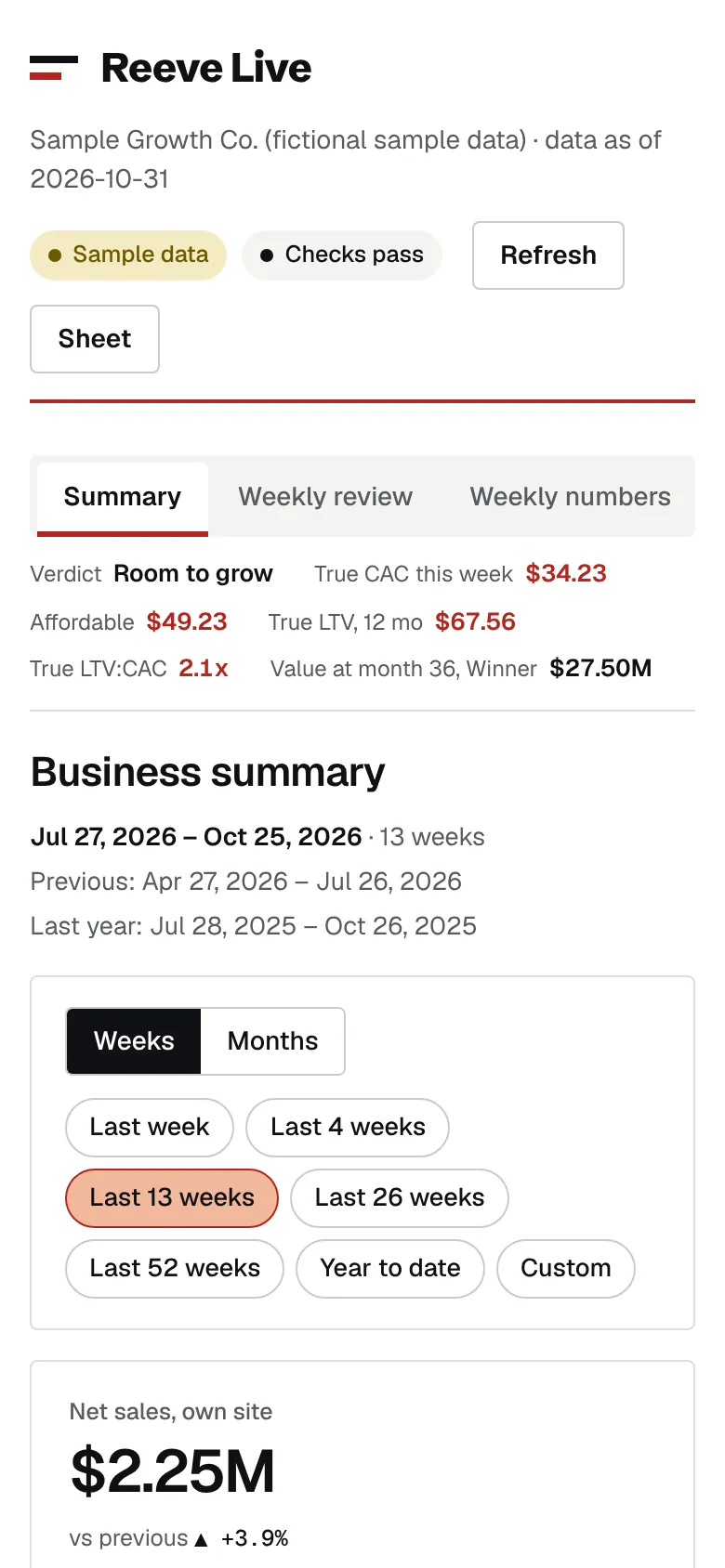
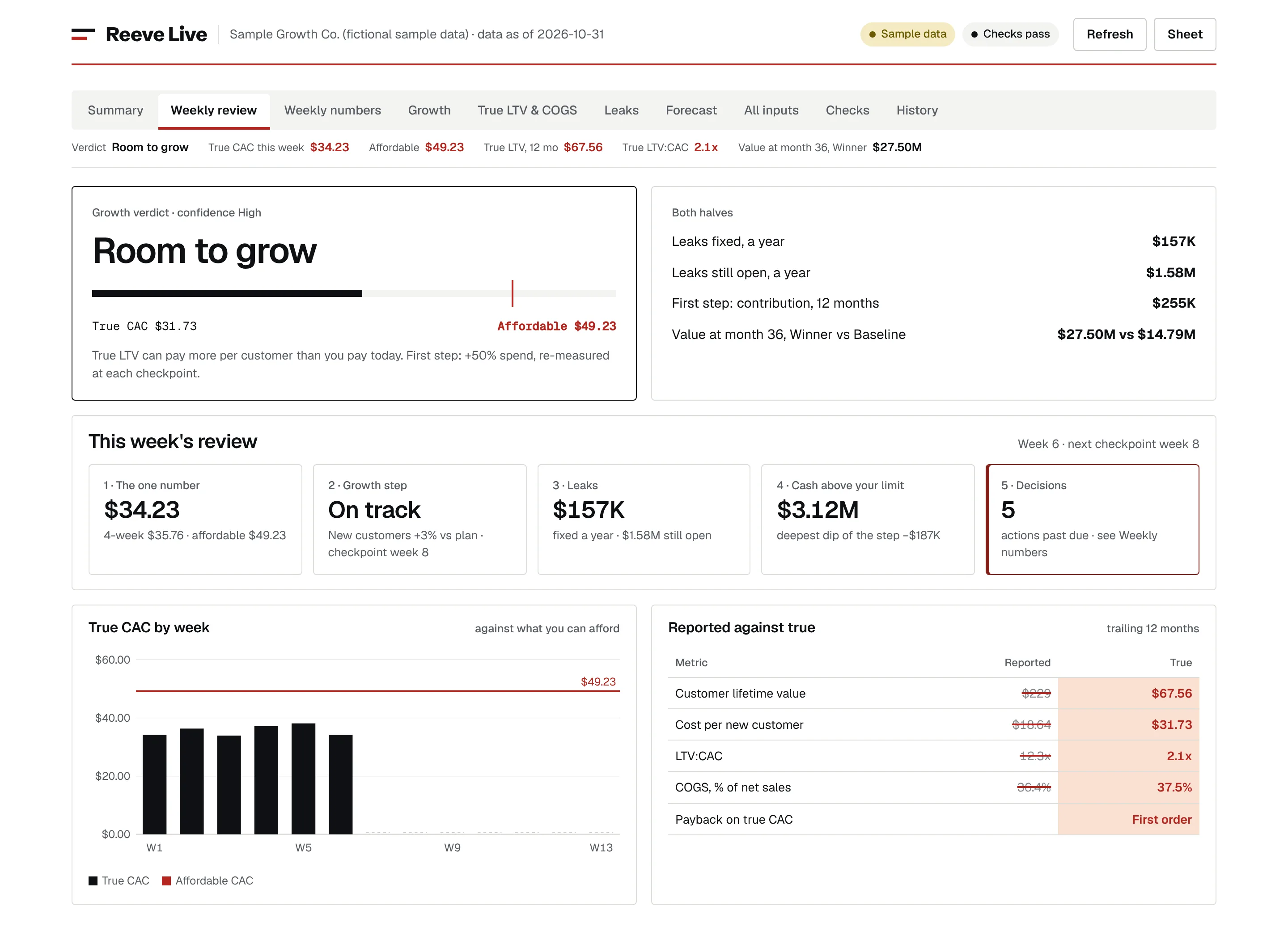
The weekly review
The 30-minute meeting runs off this screen: the one number, the growth step, leaks, cash, decisions.
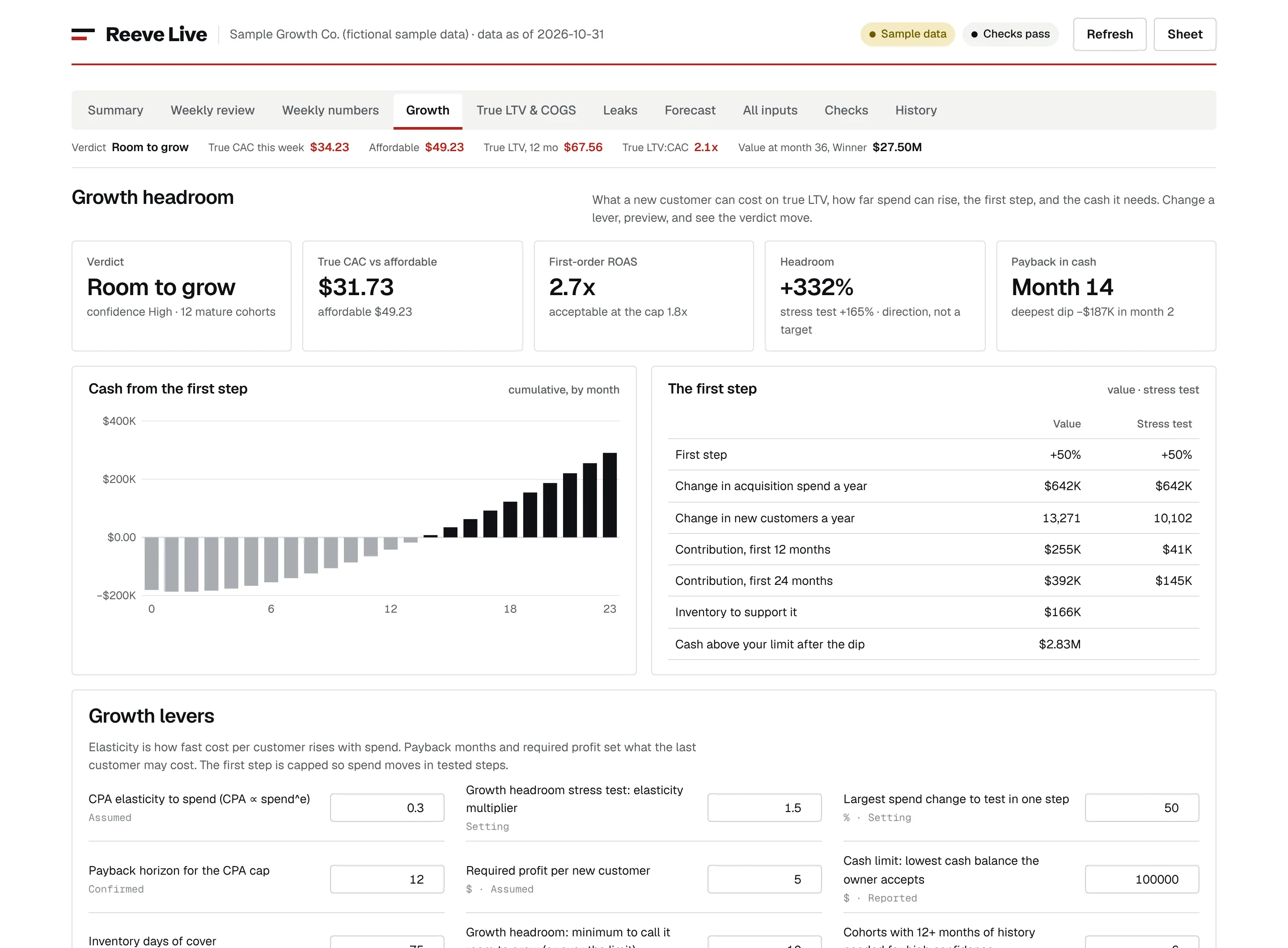
Growth headroom
What a customer can cost, the first step, and the cash it needs. Change a lever and preview it.
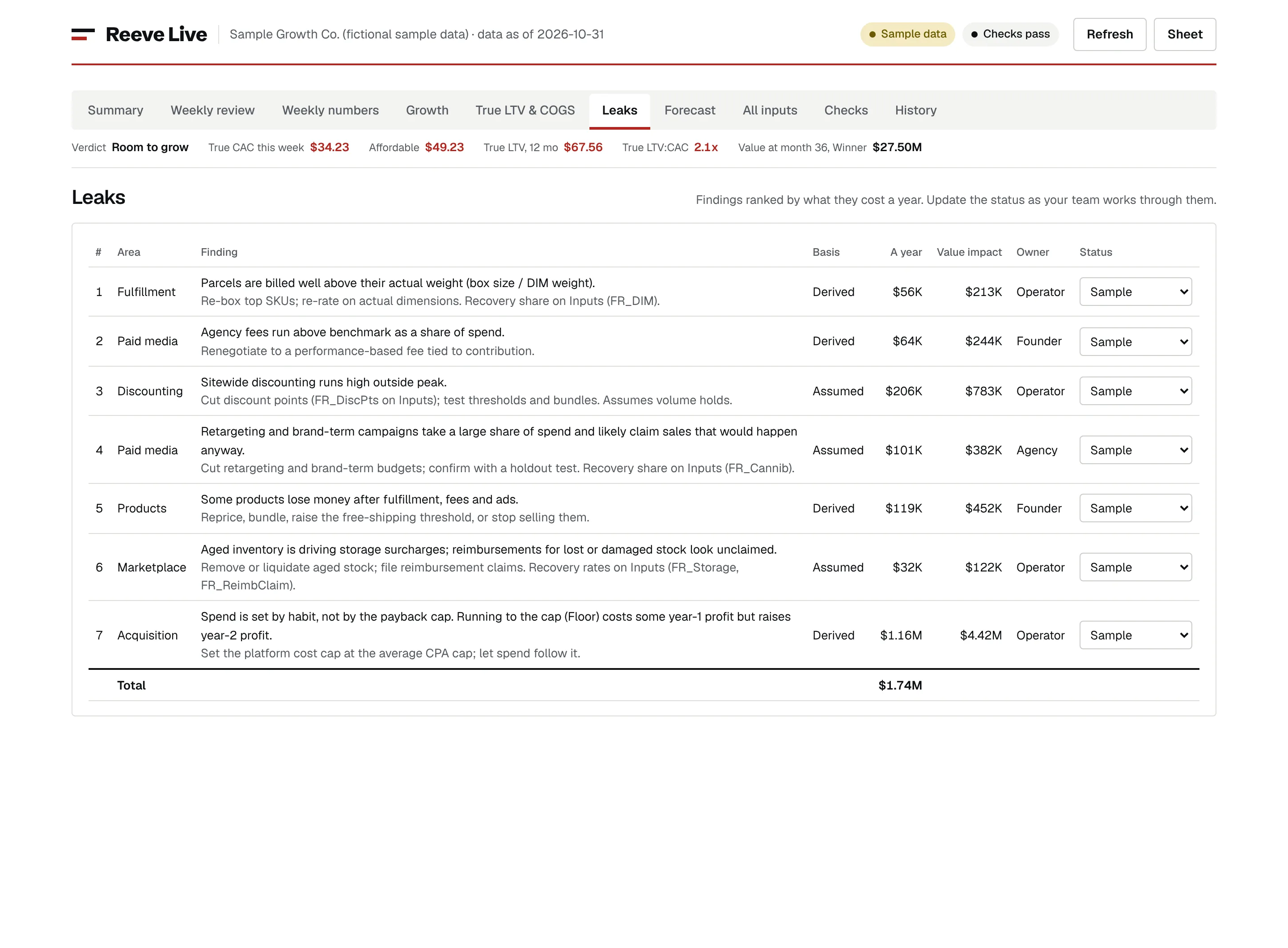
Leaks
Ranked by what they cost a year, with owners on your side and their status.
Your numbers, every week.
You see every number and every assumption behind it, the weekly brief and the action list. In the review we move the levers with you and show what each change would do. The engine behind it stays ours; your numbers are yours to export any time.
No minimum term. If it stops being useful, stop paying.
Included, every month
- Your live dashboard, on your own data
- Fast numbers refreshed weekly from your data exports: spend, new customers, what a customer really costs against what you can afford, cash
- P&L, true COGS and true LTV refreshed monthly
- A 30-minute review every week, same agenda
- A written brief and an action list, owned by your team, tracked to done
05Who we are
Twenty-five years on the operating side of commerce.
Wholesale, international trade, omnichannel retail and direct-to-consumer. We've launched and advised several brands selling into the US, Canada, the UK, the EU and Australia.

Founder
Hamed Derakhshan
Hamed Derakhshan has spent 25 years selling online and off, and paying the bills that come with it. Across wholesale, showrooms, international trade and DTC, the sales he has run or directed total more than $66M. He founded iCowhide in 2018 and built the brand from scratch to more than $36M in direct sales, running the ads, the inventory and the P&L himself, and he has helped several founders launch DTC brands past $1M. With a computer science background and a love of data, he built Reeve's engine himself, so that experience now works on the owner's side.
Why Reeve. On a medieval estate, the reeve was the owner's officer: he kept the accounts, held everyone who worked the land to what they had promised, and owned none of it. That is the job: on the owner's side, the numbers kept true, the work done by others.
Every part of the engine comes from something we got wrong, or watched someone else get wrong.
- Wholesaletaught usMargin is made or lost before a product ships.so in the engineTrue COGS is built from every invoice, not the price list.
- International tradetaught usFreight, duties, tariffs and exchange rates move margin more than most dashboards admit.so in the engineLanded cost covers every cost of getting a unit sellable, in every market.
- Direct-to-consumertaught usAd platforms report what flatters spend.so in the engineTrue CAC and true LTV come from your orders, not the ad dashboard.
- Omnichannel retailtaught usStore, ads, 3PL and accounting drift apart, quietly.so in the engineNothing reaches you until it reconciles to your books.
- Launching and advising brandstaught usThe same leaks turn up in brand after brand, market after market.so in the engineThe engine checks for every one of them, every week.
So we built the tool we always wanted: one model of the whole business, checked every time it runs, and independent of anyone who earns from your spend.
Our rules
Independent by design, so you can trust either answer.
- We never execute.We find the problem, design the change and monitor it. Your team and vendors do the work, so we never grade our own.
- We'll say stop as readily as grow.And if everything is fine, we'll say that too.
- No percentage of ad spend or revenue.Our fee doesn't grow when you spend more, or when you grow.
- No referral fees.We take nothing from agencies, 3PLs or software we recommend.
- You keep what you paid for.The plan, the reports and your data are yours. The engine that produced them stays ours.
06Questions founders ask
What if the answer is that it can't work?
We say so, in writing, with the numbers. Then we show what would have to change for it to work: what to stop now, how to buy time, and the model that could. If nothing would, we say that too, and help you stop the losses with the least damage.
Will you just tell me to cut ad spend?
Only if your numbers say so. Just as often they say the opposite: that you can afford to pay more for a customer than your agency's target allows. And often the answer isn't the ads at all, but the product, the offer or the price.
Do you do the work?
No, by design. We find the problem, design the change and monitor it. Your team and vendors make it, and we hold them to targets tied to profit. We recommend replacing a team or agency only when the evidence says so, and they get to respond first.
How sure can you be?
As sure as your data allows, and we say how sure. We need at least six months of customers with a year of history for high confidence, we stress-test every answer, and we move in steps so each one is measured before the next.
Is there a minimum term for Reeve Live?
No. If it stops being useful, stop paying. Cancel any time before the next month.
Just launched, or under $1M?
Book a free call anyway. Most of our work needs a year of orders to say anything solid, but early is when the expensive mistakes happen: hiring an agency before you know what a customer is worth, discounting to buy a launch. We'll tell you what makes sense at your stage.
What data do you need?
Your order export, supplier and freight invoices, ad accounts, marketplaces, 3PL and accounting, ideally 24 months, at least 12. View-only access, never admin. It's used only for your work, returned to you as exports, and deleted from our systems when we finish.
Not ready for a call?
Read a sample Sprint report.
A full example on a fictional brand: the leaks with their cost a year, the verdict, and whether it can be fixed.
Read the sample (PDF)Find out what's holding it back.
20 minutes, free, no pitch deck. Bring your numbers or your worry: you'll leave with an honest read and one thing to do next. If we can't help, or you don't need us, we'll say so.
How it works
- 01Pick a timeAny 20-minute slot that suits you.
- 02Four quick questionsYour revenue, where you sell, what worries you most and, if you have it, last year's P&L, so the call starts with your numbers.
- 03A call with Hamed, the founderAn honest read and one thing to do next. No pitch deck.